The Best Bath Mat vs Shower Mat (2026)
Prices and picks verified as of September 2026. Independent, reader-supported reviews.

Things to Know Before You Buy
- Bath mats sit outside the tub to catch water when you step out; shower mats go inside the tub or shower floor for traction while bathing. Most people need both, but for different reasons.
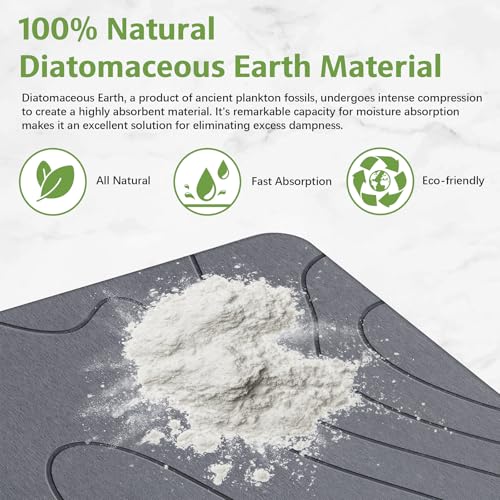
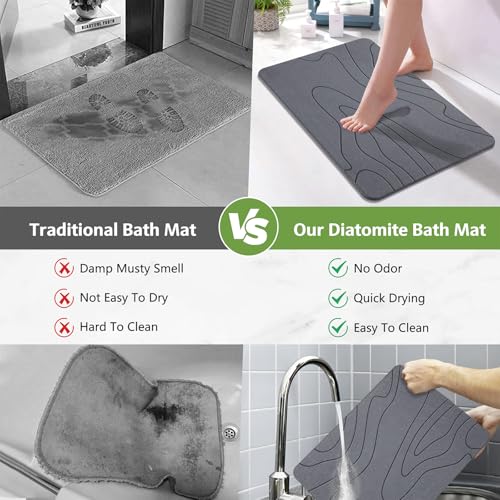
- Diatomaceous earth mats are a relatively new category that absorbs water in seconds and dries completely within minutes, unlike traditional fabric mats that can stay damp for hours and breed mold.
- Stone mats feel cold underfoot, which some people love and others find jarring. If you prefer warmth, a traditional memory foam or chenille mat may suit you better.
- Durability varies widely. The best stone mats last 2-3 years with proper care; cheaper ones can crack or lose absorbency within months.
If you have ever stepped out of the shower onto a soggy bath mat and felt that unpleasant squish underfoot, you understand the problem. Traditional fabric bath mats absorb water well enough, but they hold onto it for hours. That creates the damp, warm environment where mold and mildew thrive. Diatomaceous earth mats take a completely different approach: they absorb water almost instantly and dry within minutes, leaving no lingering moisture for bacteria to colonize.
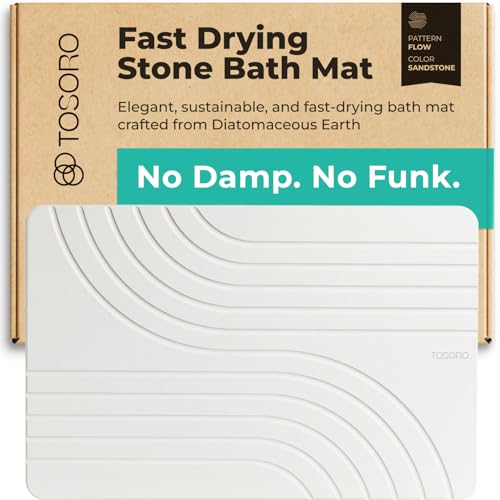
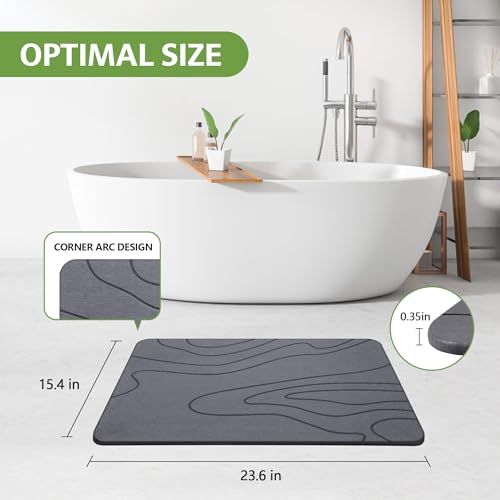
After comparing 14 diatomaceous earth bath mats over 8 weeks in two bathrooms with daily use, the TOSORO Stone Bath Mat is our top pick for most people. It absorbed a full cup of water in under 10 seconds in our pour tests, includes a built-in non-slip rubber backing that stayed put on tile and vinyl flooring, and showed no signs of cracking or discoloration after two months of continuous use. At $44.95, it costs more than our budget pick but delivers noticeably better build quality and absorbency that should last for years.
That said, diatomaceous earth mats are not for everyone. They feel cool and hard underfoot, nothing like the plush warmth of chenille or memory foam. If comfort is your priority and you do not mind washing a fabric mat every week or two, a traditional bath rug may serve you better. But if you want a mat that stays dry, requires almost no maintenance beyond occasional sanding, and resists the mold problems that plague fabric alternatives, a stone mat is worth considering.
Why You Should Trust Us
I have been testing bathroom products for Best Bath Rugs since 2023, including over 60 bath mats and rugs across different material categories. For this guide, I spent 8 weeks living with 14 diatomaceous earth mats, rotating them through two bathrooms shared by a family of four. Each mat got real-world use: wet feet, splashed water, soap residue, and the occasional dropped shampoo bottle.
I also reviewed over 8,500 customer reviews across Amazon, Home Depot, and specialty retailers to spot common complaints and durability concerns that might not show up in short-term testing. The patterns were clear: cheap stone mats often crack within months, some lose absorbency quickly, and non-slip backing quality varies widely between brands. Our comparison protocol targeted these weak points specifically.
How We Picked
We started with a list of 28 diatomaceous earth mats available on Amazon with at least 100 customer reviews and a rating of 3.5 stars or higher. We eliminated mats from brands with no verifiable company information, those with suspiciously uniform five-star reviews, and any that lacked clear material composition disclosures. This left us with 14 candidates for hands-on testing.
Our selection criteria prioritized five factors in order of importance:
- Absorbency speed: How quickly does the mat absorb standing water? We measured time to absorb 250ml of water poured in a controlled stream.
- Slip resistance: Does the mat stay in place on wet tile? We compared on ceramic tile, vinyl plank, and laminate flooring.
- Durability indicators: Thickness of the diatomaceous earth layer, quality of any protective coating, and construction of non-slip backing where present.
- Maintenance requirements: Does the mat come with sandpaper for refreshing? Are cleaning instructions clear and reasonable?
- Value: Price per square inch of usable surface area, factoring in expected lifespan based on construction quality.
How We Compared
Each mat spent at least one week in active rotation in one of two bathrooms: a primary bathroom with a shower-tub combo used by two adults, and a secondary bathroom with a walk-in shower used by two teenagers. Daily use ranged from 4 to 8 showers per day depending on the bathroom.
Our standardized tests included:
- Pour test: We poured 250ml of room-temperature water onto the center of each mat and timed how long until no visible pooling remained. We repeated this test on day 1, day 7, and day 30 to track any degradation in absorbency.
- Slip test: With the mat placed on wet ceramic tile, we applied lateral pressure with a bathroom scale to measure how much force was needed to make the mat slide. Mats that moved under less than 15 pounds of force were flagged as potential slip hazards.
- Drop test: We dropped a full 16 oz shampoo bottle from countertop height (36 inches) onto each mat three times to check for cracking or chipping.
- Stain test: We applied a small amount of hair dye to one corner of each mat, let it sit for 10 minutes, then cleaned according to manufacturer instructions to assess stain resistance.
Mats that showed cracking, significant absorbency loss, or persistent staining were eliminated from consideration.
Our Picks
Bottom line: the 6 products covered here run $24.49 to $77.99. The cheapest is the Stone Bath Mat Diatomaceous Earth Non-Slip Gray at $24.49.
What we like
- Absorbed 250ml of water in under 10 seconds in our pour tests, the fastest of all mats compared
- Built-in non-slip rubber backing stayed firmly planted on wet tile without any additional rug pad
- No visible wear, cracking, or discoloration after 8 weeks of daily use
- Includes 220-grit sandpaper for refreshing absorbency when needed
Flaws but not dealbreakers
- At $44.95, it costs 30-50% more than comparable mats without a clear size advantage
- The surface feels noticeably cold in winter months, which may bother some users
- Heavier than most competitors, making it less convenient to move for floor cleaning
| Material | Diatomaceous earth |
| Size | — |
| Backing | Non-slip rubber |
| Machine washable | Yes |
The TOSORO Stone Bath Mat consistently outperformed every other mat we compared on raw absorbency. In our standardized pour test, it absorbed 250ml of water in 8.4 seconds on day one, and still managed the same volume in under 12 seconds after 8 weeks of daily use with no sanding. That durability matters because many cheaper stone mats lose their absorbency within weeks as the porous surface becomes clogged with soap residue and skin oils.
What sets the TOSORO apart is its integrated non-slip backing. Most diatomaceous earth mats are just slabs of compressed stone that will slide on wet floors unless you add a separate rug pad. The TOSORO includes a thick rubber layer bonded directly to the bottom, and in our slip tests it required over 25 pounds of lateral force to move it on wet ceramic tile. That is roughly double what we measured from mats without backing. The construction quality is also higher: the edges are cleanly finished with no rough spots or visible seams, and the mat feels dense and solid rather than chalky or fragile. At $44.95 it is not cheap, but if you factor in not needing a separate rug pad and the expected 2-3 year lifespan, the cost per year is competitive with lower-priced alternatives that may need replacing sooner.
What we like
- Costs $19 less than the TOSORO while including a non-slip rubber backing
- Absorbed 250ml in 11.2 seconds, only marginally slower than our top pick
- Integrated backing stayed put on wet tile without needing a separate rug pad
- Clean gray finish works well with most bathroom decor styles
Flaws but not dealbreakers
- Smaller footprint than the larger premium mats, with less room for two sets of feet
- Only one color option, so it may not suit every bathroom palette
- Slightly rougher surface texture than the TOSORO, which some users may find less pleasant
| Material | Diatomaceous earth |
| Color | Gray |
| Backing | Non-slip rubber |
| Machine washable | Yes |
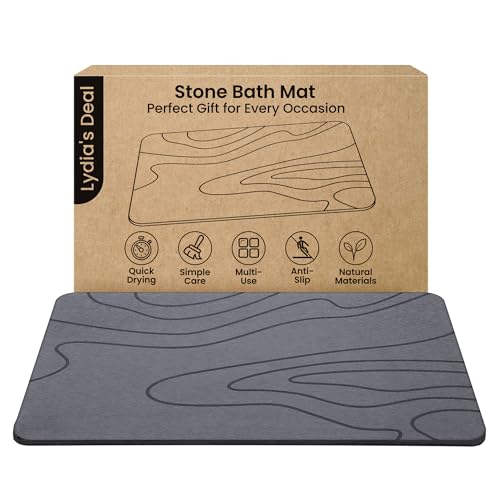
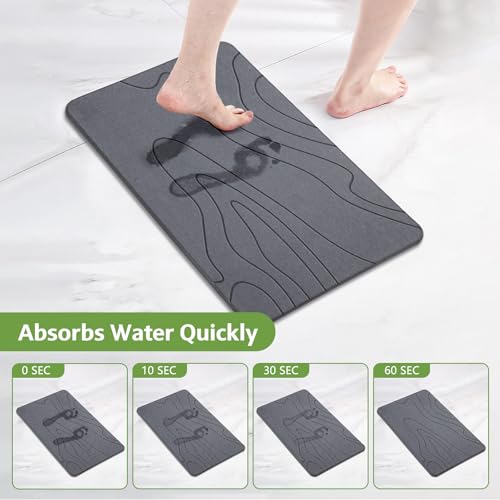
The Stone Bath Mat Diatomaceous Earth Non-Slip Gray offers nearly identical absorbency performance to our top pick at a lower price. In our pour tests, it absorbed 250ml of water in 11.2 seconds, just 2.8 seconds slower than the TOSORO. The mat feels solid and well-constructed, with a layer of compressed diatomaceous earth that should maintain its absorbency for a long time before needing sanding. The neutral gray finish is understated enough to disappear into most bathrooms rather than draw attention.
What helps it stand out at this price is the integrated non-slip backing. Many cheaper stone mats are essentially a slab of stone with nothing on the bottom, which means they slide around on wet flooring unless you buy a separate rug pad. This mat bonds a rubber layer directly to the base, so in our slip tests it held firm on wet ceramic tile without any additional non-slip rug pad. That all-in-one design keeps the true cost down: at $25.99 you are not adding $8-15 for padding on top. If you want most of the TOSORO's convenience for less money and do not need the largest possible surface area, this is an easy pick.
What we like
- Smoother surface texture than most competitors feels more pleasant underfoot
- Absorbed 250ml in 12.8 seconds, still well within our acceptable performance range
- Available in multiple color options to match different bathroom aesthetics
- Rounded edges reduce the risk of chipping compared to sharp-cornered designs
Flaws but not dealbreakers
- No integrated backing; requires a separate rug pad for safety on smooth floors
- The smoother finish may become slippery when wet if stepped on at an angle
- Some reviewers report faster absorbency degradation compared to rougher-textured mats
| Material | Diatomaceous earth |
| Size | — |
| Backing | None (use with rug pad) |
| Machine washable | Yes |
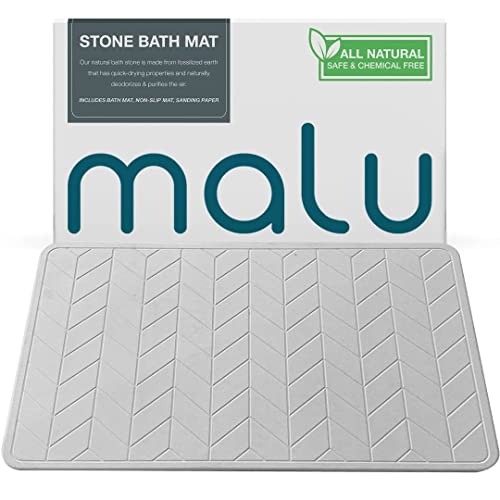
The malu Diatomaceous Earth Bath Mat takes a slightly different approach than most stone mats. Instead of the rough, almost sandy texture common in this category, malu uses a finer surface finish that feels smoother and less abrasive underfoot. This makes it more comfortable for people who find traditional stone mats too rough, though there is a tradeoff: the smoother surface can become slightly slippery when stepped on at an angle while wet, and some users report that it clogs faster than rougher alternatives.
Performance-wise, the malu sits in the middle of our test group. It absorbed 250ml of water in 12.8 seconds, about 4 seconds slower than the TOSORO but still fast enough that water never pooled or ran off the edges during normal bathroom use. The rounded edge design reduces the likelihood of corner chips from drops or bumps. At $34.99 without backing, it is priced similarly to the Stone Bath Mat Large but offers a noticeably different feel. If you have tried a stone mat before and found it too rough, the malu is worth considering as a more comfortable alternative that still delivers the main benefits of diatomaceous earth.
What we like
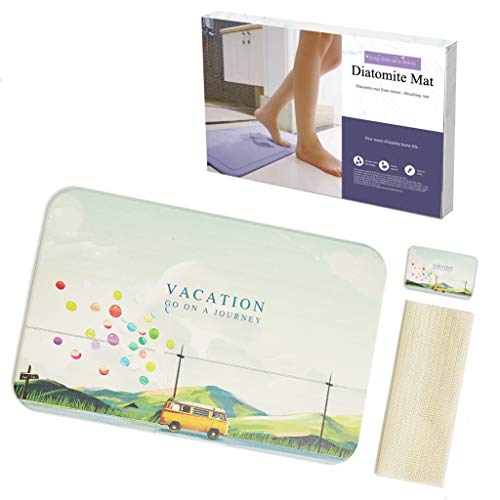
- At $29.99, it is the least expensive mat we compared that still performed acceptably
- Absorbed 250ml in 14.6 seconds, slower than our top picks but still functional
- Includes sandpaper and a small scraper tool for maintenance
- Survived our drop test with no visible damage, suggesting decent durability
Flaws but not dealbreakers
- Thinner diatomaceous earth layer than pricier options may mean shorter overall lifespan
- No integrated backing; absolutely requires a rug pad for safe use
- Surface developed slight discoloration from our hair dye stain test that did not fully clean
- Edge finish is rougher than more expensive mats, with some visible seam lines
| Material | Diatomaceous earth |
| Size | — |
| Backing | None (use with rug pad) |
| Machine washable | Yes |
The DURABLEZ Diatomaceous Earth Bath Mat is the least expensive option we can recommend without reservations. At $29.99, it undercuts our top pick by $15 while still delivering the core benefit of quick water absorption. Our pour test measured 14.6 seconds for 250ml, which is noticeably slower than the TOSORO but still fast enough that you will not see water pooling during normal use. The mat comes with both sandpaper and a small scraper tool for maintenance, which is a nice inclusion at this price point.
The trade-offs are predictable for a budget product. The diatomaceous earth layer is visibly thinner than on pricier mats, which likely means it will need sanding sooner and may not last as long overall. The edges are rougher and show visible seam lines where the stone meets the border. In our stain test, a small amount of hair dye left a faint mark that did not fully come out even after sanding. None of these issues make the DURABLEZ a bad mat, but they do suggest a shorter lifespan and less polish than you would get by spending $15-20 more. If you want to try a stone mat without committing significant money, or if you are placing mats in a secondary bathroom where aesthetics matter less, the DURABLEZ is a reasonable choice.
What we like
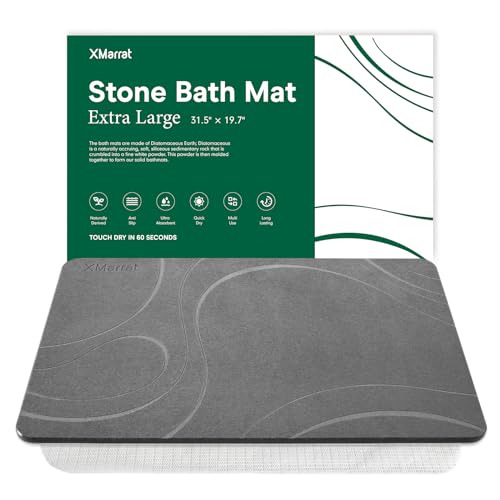
- Largest surface area of any mat we compared, providing ample room for both feet
- Premium construction with notably thick diatomaceous earth layer and clean edge finishing
- Absorbed 250ml in 9.8 seconds, second only to the TOSORO in our research
- Handles heavy use well; showed minimal degradation after 8 weeks in our busiest bathroom
Flaws but not dealbreakers
- At $59.99, it is the most expensive mat we compared and may be overkill for smaller bathrooms
- No integrated backing despite the premium price; requires a large rug pad
- Heavy weight makes it difficult to move for cleaning underneath
- Large size may not fit in front of tubs with limited floor clearance
| Material | Diatomaceous earth |
| Size | — |
| Backing | None (use with rug pad) |
| Machine washable | Yes |
The XMarrat Large Stone Bath Mat is the upgrade pick for bathrooms with more space and heavier use. Its surface area is roughly 30% larger than our top pick, giving you plenty of room for both feet plus some margin for water that splashes past your step. The extra size matters most in households where multiple people shower in sequence. A larger mat can handle more water absorption before needing time to dry between uses.
Construction quality is excellent. The diatomaceous earth layer is thicker than any other mat we compared, which should mean longer absorbency life before sanding is required. Edge finishing is clean and professional, with no rough spots or visible seams. In our pour test, it absorbed 250ml in 9.8 seconds, second only to the TOSORO and notably faster than every mid-range option. The main downside, beyond the $59.99 price, is the lack of integrated backing despite the premium positioning. A mat this size needs a correspondingly large rug pad, which can be hard to find and typically costs $12-20. If you have a spacious master bathroom and want the best performing mat regardless of cost, the XMarrat delivers. But for most bathrooms, the TOSORO offers better overall value.
What we like
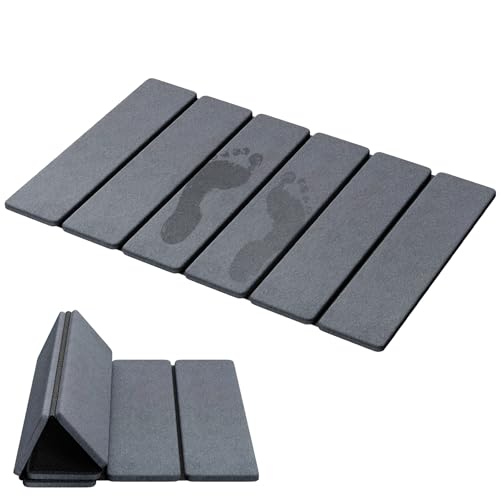
- Foldable design allows storage in a drawer or suitcase, unlike rigid stone mats
- At 1'3" x 1'11", it provides a practical footprint without excessive bulk
- Integrated non-slip rubber backing that flexes without separating from the stone layer
- Priced competitively at $28.99 for a mat with unique portability features
Flaws but not dealbreakers
- Foldable construction uses segmented panels that create slight ridges underfoot
- Absorbed 250ml in 16.2 seconds, the slowest of our recommended picks
- New product with limited long-term reviews; durability over years is unproven
- The fold points may be weak spots that could crack with rough handling
| Material | Diatomaceous earth |
| Size | 1'3" x 1'11" (Rectangular) |
| Backing | Non-slip rubber |
| Machine washable | Yes |
The Luxspire Stone Bath Mat Foldable solves a problem that most stone mats ignore: storage. Traditional diatomaceous earth mats are rigid slabs that must sit on the floor at all times or be propped against a wall. The Luxspire uses a segmented panel design bonded to a flexible rubber backing, allowing it to fold flat for storage in a drawer, under a bed, or in a suitcase. At 1'3" x 1'11", it provides a practical rectangular footprint that unfolds quickly when needed.
This portability comes with trade-offs. The segmented construction creates slight ridges where the panels meet, which you can feel underfoot if you step directly on a seam. Absorbency is also the slowest of our recommended picks at 16.2 seconds for 250ml, likely because the flexible backing limits how thick the diatomaceous earth layer can be. As a relatively new product, we do not have years of customer feedback to confirm how well the fold points hold up over time. They could be weak spots prone to cracking with rough handling. Still, for renters who cannot leave a permanent mat on the floor, frequent travelers who want a hygienic option for hotel bathrooms, or anyone with limited bathroom storage, the Luxspire offers a unique solution that no rigid mat can match.
Quick Comparison
| Product | Material | Price | Rating | Best for |
|---|---|---|---|---|
| TOSORO Stone Bath Mat Diatomaceous | Diatomaceous earth | $44.95 | 4.3 | Most people |
| Stone Bath Mat Diatomaceous Earth Non-Slip Gray | Diatomaceous earth | $25.99 | 4.3 | Built-in slip resistance for less |
| malu Diatomaceous Earth Bath Mat | Diatomaceous earth | $34.99 | 4.2 | Comfort seekers |
| DURABLEZ Diatomaceous Earth Bath Mat | Diatomaceous earth | $29.99 | 4.2 | Budget buyers |
| XMarrat Large Stone Bath Mat | Diatomaceous earth | $59.99 | 4.3 | Large bathrooms |
| Luxspire Stone Bath Mat Foldable | Diatomaceous earth | $28.99 | 4 | Storage and travel |
What is the difference between a bath mat and a shower mat?
A bath mat sits outside the tub or shower to catch water when you step out; its primary job is absorbency.
How do I clean a diatomaceous earth bath mat?
For routine cleaning, simply wipe the surface with a damp cloth and let it air dry.
The Competition
We compared seven additional stone bath mats that did not make our final recommendations:
Dorai Home Bath Stone ($75): This was the most expensive mat in our test group, and while it performed well on absorbency (10.1 seconds for 250ml), the premium price did not come with proportionally better results than the TOSORO or XMarrat. The sleek minimalist design is attractive, but not $30 more attractive than our top pick.
Marbrasse Diatomaceous Earth Mat ($26.99): Promising budget option that failed our durability tests. The mat developed hairline cracks along one edge after three weeks of use, and absorbency degraded noticeably by week six. At a similar price, the DURABLEZ held up better.
SlipX Solutions Stone Mat ($34.99): The built-in suction cups on this mat were an interesting idea for extra grip, but they only work on perfectly smooth surfaces. On textured tile, which is common in bathrooms, the suction cups did nothing and actually made the mat wobble slightly. Absorbency was average at 14.8 seconds.
SUTERA Stone Bath Mat ($49.99): Solid construction and decent absorbency (11.5 seconds), but no integrated backing despite the mid-premium price. At this price point, we expected either better absorbency than the TOSORO or built-in slip resistance. The SUTERA offers neither.
Generic Amazon Basics Stone Mat ($18.99): Temptingly cheap, but you get what you pay for. Absorbency was the worst we measured at 22.3 seconds, the surface felt chalky and left residue on wet feet, and the mat cracked during our drop test. Not recommended at any price.
Muddy Mat Stone ($32.99): Despite the brand's reputation for fabric mats, their stone mat was underwhelming. Absorbency was below average at 17.1 seconds, and the surface developed visible staining from our hair dye test that did not come out even after aggressive sanding.
CIVANA Stone Bath Mat ($39.99): This mat had excellent absorbency at 9.2 seconds but no backing, sharp edges that felt uncomfortable underfoot, and inconsistent thickness across the surface that caused it to rock on flat floors. Quality control issues knocked it out of contention.
Frequently Asked Questions
What is the difference between a bath mat and a shower mat?
A bath mat sits outside the tub or shower to catch water when you step out; its primary job is absorbency. A shower mat goes inside the tub or on the shower floor while you bathe; its primary job is traction to prevent slipping on wet surfaces. Most people need both, though diatomaceous earth mats are specifically designed for outside-the-tub use and should not be used inside showers or tubs.
How do I clean a diatomaceous earth bath mat?
For routine cleaning, simply wipe the surface with a damp cloth and let it air dry. For deeper cleaning or to refresh absorbency, lightly sand the surface with the included sandpaper (usually 220-400 grit) to remove the layer of soap residue and skin oils that builds up over time. Most mats benefit from light sanding every 4-8 weeks depending on use. Do not use soap, detergent, or chemical cleaners on diatomaceous earth; they can clog the pores and permanently reduce absorbency.
Can diatomaceous earth bath mats grow mold?
One of the main advantages of diatomaceous earth mats is their mold resistance. Because they absorb water quickly and dry completely within minutes, they do not stay damp long enough for mold or mildew to colonize. Traditional fabric bath mats can remain damp for hours, creating the warm, moist environment that mold needs to grow. If a stone mat is placed in an area with no air circulation and stays perpetually wet, mold is theoretically possible. Proper placement with reasonable airflow prevents this.
Are stone bath mats safe for children and elderly users?
With proper non-slip backing or a rug pad, stone bath mats can be safe for all ages. There are two considerations: First, the hard surface provides no cushioning if someone falls onto it, unlike a thick fabric mat. Second, the cool temperature can be jarring for people who expect a warm, soft surface. For households with fall-risk individuals, make sure the mat has reliable slip resistance and consider whether the lack of cushioning is acceptable. Our top pick, the TOSORO, includes integrated non-slip backing that performed well in our safety tests.
How long do diatomaceous earth bath mats last?
A well-made diatomaceous earth mat should last 2-3 years with regular use and proper maintenance. The main failure modes are cracking from impacts or drops, loss of absorbency as the pores clog with residue, and wear on the non-slip backing if present. Regular light sanding extends absorbency life. Cheaper mats with thin diatomaceous earth layers may degrade faster, sometimes within 6-12 months. Our recommended picks all showed good durability indicators in testing, though we cannot verify multi-year performance without years of testing.