Bath Rug Size Guide 2026: Standard Sizes + Comparison Chart
This article contains affiliate links. If you buy through our links, we may earn a commission at no cost to you. Full disclosure.

Things to Know
- The most popular bath rug size is 20x32 inches, which fits the majority of standard bathrooms in front of a tub or shower.
- Measure the floor space where you step out of the shower, then add 2-3 inches on each side. The rug should catch both feet without your toes landing on wet tile.
- Door clearance is the mistake most people overlook. A rug that jams against a swinging door will bunch up, lose its non-slip grip, and become a tripping hazard.
- For most people, one medium rug in front of the tub and a small rug at the vanity covers the entire bathroom. Skip the matching 3-piece set unless your layout genuinely needs it.
Why Size Matters More Than Material
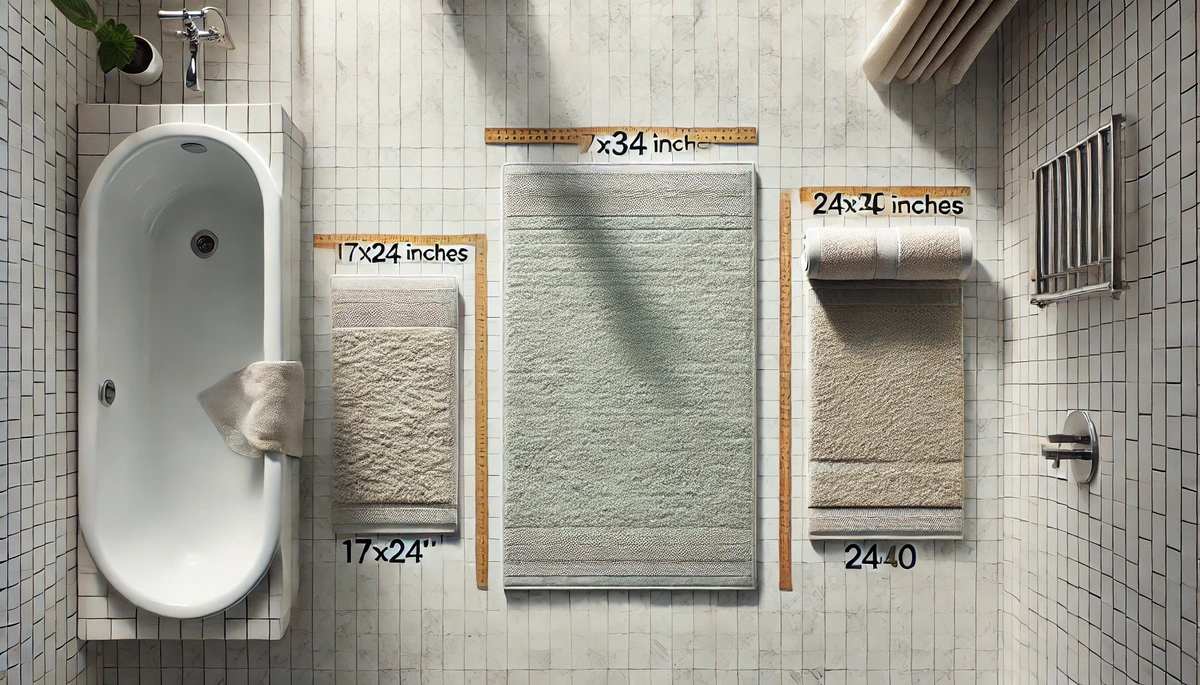
What's the standard bathroom rug size? The most commonly purchased size is 20 x 32 inches (sometimes labeled 21 x 34) — it fits the majority of standard tub-shower combos and powder rooms. The average bathroom rug size across all US households falls between 17 x 24 (small/powder room) and 24 x 36 (standard bath); larger 27 x 45 and runner-style 24 x 60 sizes are reserved for master suites and double-vanity layouts. The full comparison chart below breaks down which size fits which bathroom.
Most bath rug shopping guides start with material. That is backwards. The wrong size creates problems that no amount of plush memory foam or quick-dry microfiber can fix. An undersized rug leaves patches of wet tile between the tub and the vanity. An oversized one bunches against cabinets, rides up under doors, and curls at the edges because there is nowhere for it to lay flat.
A properly sized bath rug does three things. It catches water before it reaches the floor, keeps your feet off cold tile, and stays flat enough that nobody trips on it. Everything else, including material, color, and pile height, is secondary to those three functions. The National Kitchen and Bath Association (NKBA) emphasizes clear floor paths and adequate clearance for doors and drawers in every bathroom design guideline, and your rug choice should respect those principles.
The good news is that bath rugs come in a relatively small number of standard sizes, and matching them to your bathroom is straightforward once you know the rules. The chart below covers every common bathroom layout, from a half-bath powder room to a large master suite.
Bath Rug Size Comparison: Standard Sizes Side-by-Side
| Size (inches) | Also Labeled | Best For | Typical Placement |
|---|---|---|---|
| 17x24 | Small | Powder rooms, pedestal sinks, toilet areas | In front of sink or beside toilet |
| 20x32 | Medium / Standard | Standard tubs, shower stalls, guest baths | In front of tub or shower door |
| 24x36 | Large | Full baths with wider tubs, family bathrooms | Along tub side, centered on exit point |
| 24x40 | Extra Large | Master baths, double vanities, large showers | Between tub/shower and vanity |
| 24x60 | Runner | Long/narrow bathrooms, double-sink vanities | Along vanity length or between fixtures |
| Round (27-30") | Novelty / Accent | Freestanding tubs, decorative accents | Centered in front of freestanding tub |
| Contour | Toilet rug | Around toilet base | Wraps around toilet pedestal |
How to Measure Your Bathroom for a Rug
Measuring takes about two minutes and prevents the most common sizing mistakes. Here is the process that works for every bathroom layout.
Step 1: Identify your exit point
Stand in front of your tub or shower and note where your feet land when you step out. That landing zone is the center of where your rug should go. For most tubs, this is roughly the middle of the long side. For shower stalls, it is directly in front of the door.
Step 2: Measure the landing zone
Using a tape measure, mark the floor area you want covered. For a tub exit, measure from the tub edge outward at least 24 inches, ideally 30-36 inches. The rug width should equal or exceed the tub opening where you step out, typically 24-32 inches.
Step 3: Check clearances
This is the step most people skip, and it is the one that causes the most problems. Open every door and drawer in the bathroom. Pull out every cabinet. If the rug extends into any of those swing paths, either choose a smaller size or shift the rug placement. A rug that gets caught under a door will bunch, lose its backing, and wear out much faster than it should.
Step 4: Consider your vanity
If your vanity is close to the tub (under 36 inches of floor space between them), one medium rug may cover both zones. If the vanity is farther away, consider a separate small rug (17x24) in front of the sink. Standing at the vanity on cold tile while brushing teeth is exactly the kind of discomfort a second rug solves cheaply.
Room-by-Room Sizing Recommendations
Powder room / half bath
Powder rooms typically measure 3x5 feet or 3x6 feet. There is no tub or shower, so the only rug placement is in front of the sink. A 17x24 small rug is the right choice for most powder rooms. Anything larger will crowd the floor and make the room feel even smaller than it is. Because powder rooms see less water than full bathrooms, a cotton or microfiber rug works well here.
Standard full bathroom (5x8 feet)
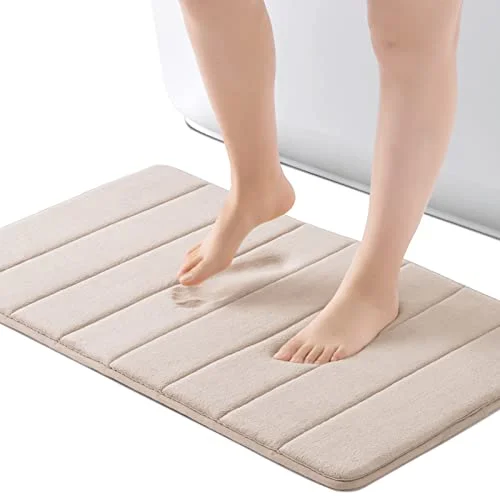
The classic American bathroom layout with a tub/shower combo along one wall and a single vanity opposite. A 20x32 rug in front of the tub handles the primary stepping zone. If the vanity is directly across from the tub (which it usually is in this layout), the tub rug may be close enough to serve double duty. If not, add a 17x24 rug at the vanity.
In this layout, non-slip backing is critical because the distance between fixtures is short and a rug that slides even a few inches can end up bunched against the vanity base.
Family bathroom (7x9 feet or larger)
Larger family bathrooms often have a separate shower stall and bathtub, or a tub with more open floor space around it. A 24x36 or 24x40 rug gives better coverage for the primary stepping zone. The extra width matters when multiple family members use the bathroom in quick succession, because water accumulates faster. If you have kids, our non-slip bath rug guide covers options with extra grip that also meet the sizing needs of family bathrooms.
Master bathroom
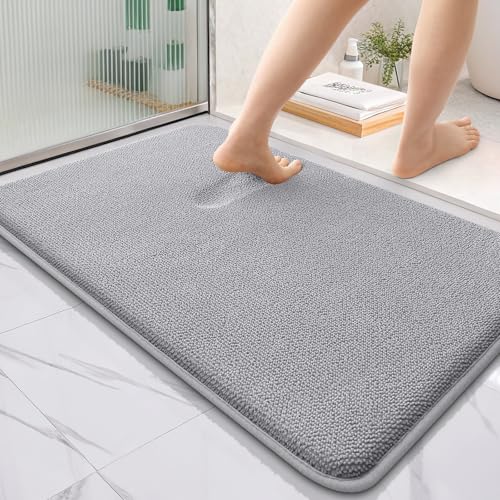
Master bathrooms with double vanities, separate showers, and soaking tubs need a zoned approach rather than one large rug. Consider a 24x40 or 24x60 runner between the shower and vanity, plus a separate rug near the soaking tub. This is one of the few cases where a matching rug set makes practical sense, because the visual continuity across a large space keeps the room looking intentional rather than patched together.
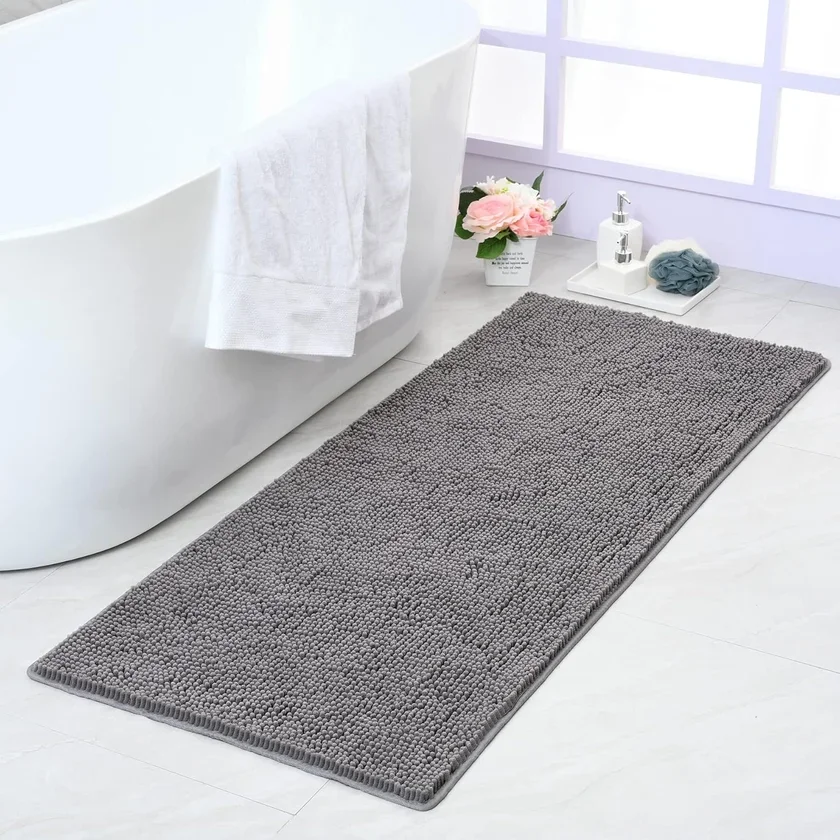
For master baths, quick-dry materials matter more than in smaller rooms, because larger rugs take longer to dry and master baths often have more moisture sources (steam showers, soaking tubs, larger shower heads).
Long, narrow bathrooms
Galley-style bathrooms (common in apartments and older homes) present a unique challenge. A standard rectangular rug may block the walkway. A 24x60 runner laid along the long axis works better, providing coverage from the tub to the vanity without narrowing the walking path. Just make sure the runner does not reach so close to the door that it blocks the swing.
The 3-Piece Set: Do You Actually Need One?
Bath rug sets typically include a 20x32 tub mat, a 17x24 vanity mat, and a contour rug for the toilet. They are popular because they look coordinated and cost less per piece than buying separately. But for most bathrooms, a 3-piece set includes at least one piece you do not need.
The contour toilet rug is the most debatable piece. Hygienically, a rug that wraps around the base of a toilet traps moisture and requires frequent washing. Practically, most people forget to wash it as often as the tub rug, which defeats the purpose. If you do want a toilet rug, buy it separately so you can replace it more often without throwing out the entire set.
The vanity rug from a 3-piece set is often too large for small bathrooms where the tub and vanity are close together. Measure your space first, and only buy the set if all three pieces have a genuine placement in your layout.
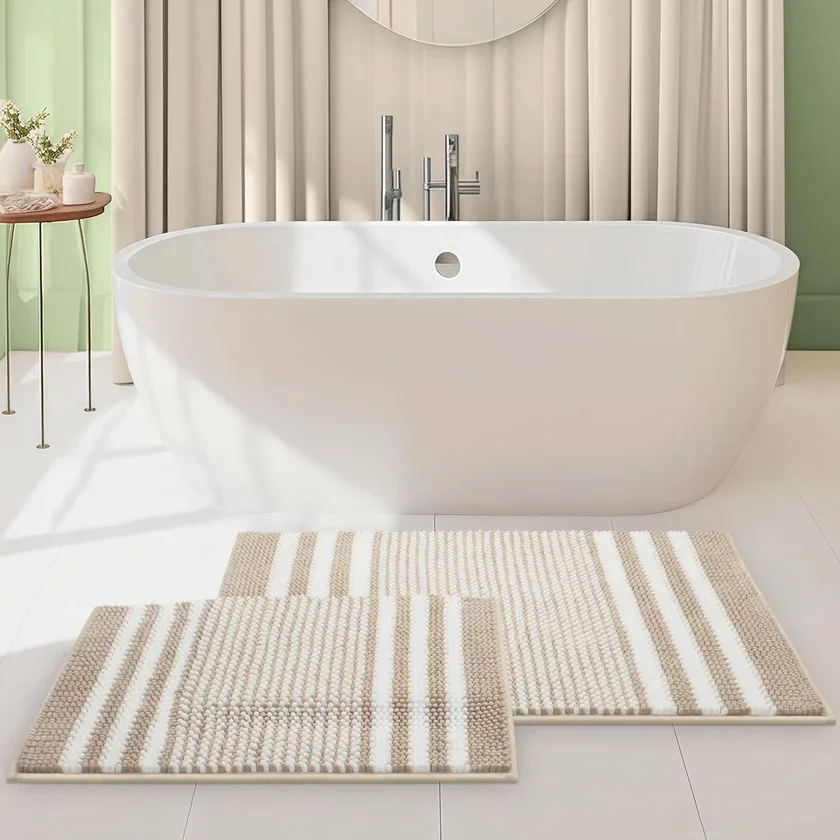
Size and Material Interactions
Size affects how a rug performs in ways that are not obvious until you live with it. A large memory foam rug (24x40 or bigger) is significantly heavier than a small one, especially when wet, and may not fit in a standard residential washing machine. If you choose a large memory foam rug, check that your washer can handle the weight. For details on care by material, see our complete bath rug care guide.
Thicker materials in larger sizes also take much longer to dry. A 17x24 chenille rug air dries in a few hours. A 24x60 chenille runner can take a full day. In humid bathrooms, that drying time creates an environment where mold and odor develop, which is why quick-dry materials become more important as rug size increases.
| Size | Avg. Weight (dry) | Machine Washable? | Avg. Dry Time |
|---|---|---|---|
| 17x24 | 0.5-1.0 lb | Yes, any washer | 2-4 hours (air) |
| 20x32 | 1.0-2.0 lbs | Yes, any washer | 3-6 hours (air) |
| 24x36 | 1.5-3.0 lbs | Yes, standard washer | 4-8 hours (air) |
| 24x40 | 2.0-4.0 lbs | Check capacity | 6-10 hours (air) |
| 24x60 | 3.0-6.0 lbs | Large capacity only | 8-14 hours (air) |
Special Sizing Situations
Walk-in showers without a door
Doorless walk-in showers splash water over a wider area than enclosed tubs. For these layouts, go one size up from what the floor space suggests. A 24x36 or 24x40 rug placed just outside the shower threshold captures the wider splash zone. If the shower is curbless (flush with the floor), the rug also acts as a visual and tactile boundary, which is important for safety, particularly for elderly users.
Freestanding tubs
Freestanding soaking tubs are typically centered in the room with open floor on all sides. A round rug (27-30 inches diameter) placed on the primary exit side works well aesthetically and functionally. Alternatively, a 24x40 rectangular rug in front of the tub provides more coverage. The key is to choose based on where you actually step out, not on what looks symmetrical from above.
Heated bathroom floors
If your bathroom has radiant floor heating, you may not need a rug for warmth at all. In that case, size your rug purely for water absorption and slip prevention. A thinner, smaller rug works fine since the floor itself handles the comfort factor. Make sure the rug's backing is compatible with heated floors. PVC backing can damage heated tile; TPR (thermoplastic rubber) is the safer option.
Accessibility considerations
The ADA design standards recommend keeping pathways at least 36 inches wide and ensuring floor coverings do not create tripping hazards. For accessible bathrooms, choose a rug that provides coverage without narrowing walkways, and prioritize firm, low-pile rugs over thick, plush options that can catch wheelchair wheels or walker legs.
How to Know If Your Current Rug Is the Wrong Size
You probably do not need to measure anything to figure this out. These are the signs:
- Your feet land partly on tile when exiting the shower. The rug is too small or poorly positioned.
- The bathroom door drags over the rug. Too large, or the wrong shape for the layout.
- The edges curl up. The rug is being pushed against a wall or fixture with no room to lie flat.
- The rug slides when you step on it. Could be a backing issue, but oversized rugs with unsupported edges are also more prone to sliding. See our anti-sliding guide for fixes.
- The rug smells musty despite washing. Large rugs in small bathrooms cannot dry properly. Downsizing may fix the problem. Our smell troubleshooting guide covers this in detail.
Our Recommended Sizes by Bathroom Type
| Bathroom Type | Room Size | Recommended Rug(s) | Notes |
|---|---|---|---|
| Powder room | 3x5 to 3x6 ft | 1x small (17x24) | In front of sink only |
| Standard full bath | 5x8 ft | 1x medium (20x32) | Add small at vanity if space allows |
| Family bath | 7x9 ft | 1x large (24x36) + 1x small | Large at tub, small at vanity |
| Master bath | 8x10+ ft | 1x XL or runner + 1-2 medium | Zone each fixture separately |
| Narrow/galley | 4x10+ ft | 1x runner (24x60) | Along the long axis only |
What's the standard bathroom rug size?
The standard bathroom rug size is 20 x 32 inches (also sold as 21 x 34) — that's the most-bought single size on Amazon and the one that fits the majority of US bathtub-shower combos and standard powder rooms.
What's the average bathroom rug size?
The average bathroom rug size in US households falls between 20 x 32 and 24 x 36 inches.
Frequently Asked Questions
What's the standard bathroom rug size?
The standard bathroom rug size is 20 x 32 inches (also sold as 21 x 34) — that's the most-bought single size on Amazon and the one that fits the majority of US bathtub-shower combos and standard powder rooms. 17 x 24 is the standard "small" or accent size, 24 x 36 is the standard "large" for full bathrooms with double-vanity layouts, and 24 x 60 is the runner standard for galley-style master baths. See the comparison chart above for exact dimensions and recommended bathroom matches.
What's the average bathroom rug size?
The average bathroom rug size in US households falls between 20 x 32 and 24 x 36 inches. Smaller bathrooms (under 5 x 7 ft) typically use 17 x 24 or 20 x 32 rugs; standard bathrooms (5 x 8 to 6 x 9 ft) use 21 x 34 or 24 x 36; large master baths use 27 x 45 or pair a 24 x 36 in front of the tub with a 24 x 60 runner along the vanity. For an exact match to your room dimensions, our small-bathroom guide and Room-by-Room Sizing section above narrow it further.
What size bath rug do I need for a standard bathtub?
A 21x34 or 24x36 rug works for most standard bathtubs. The rug should extend 2-3 inches beyond the tub on each side where you step out, so both feet land fully on the rug. Measure from the tub edge outward at least 24 inches to ensure adequate coverage.
Should a bath rug go under the toilet?
No. Placing a rug under or around a toilet traps moisture and bacteria, creating hygiene problems. If you want a rug near the toilet, use a separate contour rug designed for that purpose, and wash it weekly. A standard rectangular bath rug belongs in front of the tub or shower, not under fixtures.
What is the most common bath rug size?
The most commonly purchased bath rug size is 20x32 inches (sometimes labeled 21x34). This medium size fits the majority of standard bathrooms and provides adequate coverage in front of a tub or shower stall. It is also the easiest size to wash and dry at home.
How do I measure for a bath rug?
Measure the floor area where you step out of the tub or shower. The rug should be at least as wide as the tub opening and extend 24-36 inches outward. Then check that the rug will not block doors, drawers, or cabinets. Leave 3-4 inches between the rug edge and any wall or fixture.
Can I use a large area rug instead of a bath rug?
Not recommended. Area rugs are not designed for wet environments. They lack non-slip backing, absorb water poorly, and can develop mold quickly in humid bathrooms. Bath rugs are engineered with water absorption, quick-dry properties, and slip-resistant backing that standard area rugs simply do not have.
How often should I replace my bath rug?
Replace bath rugs every 1-2 years depending on usage and material quality. Signs it is time for a new one include flattened pile that no longer bounces back, persistent odor after washing, curling edges, or non-slip backing that has become smooth or is flaking off. Higher-quality rugs like luxury spa-grade options typically last longer.